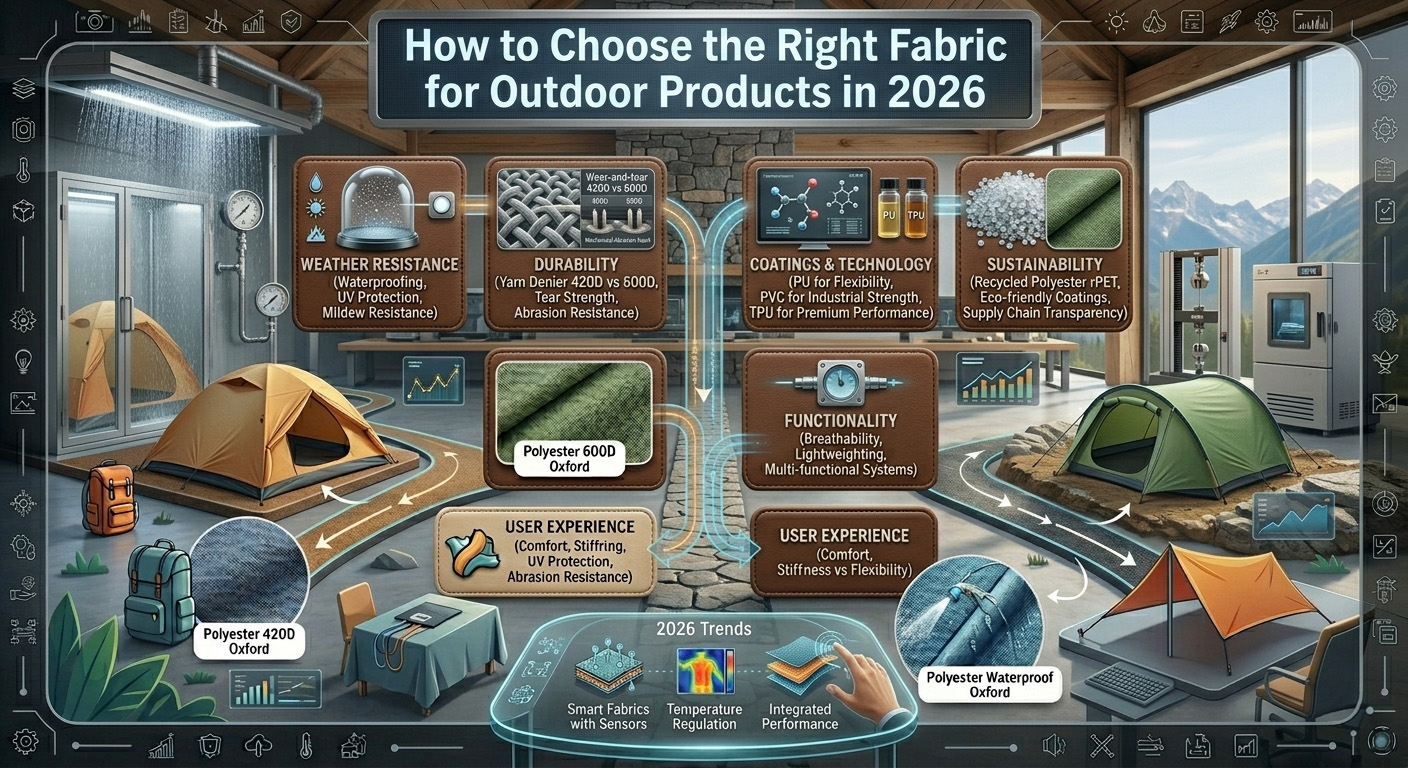
Selecting the right outdoor fabric in 2026 is no longer a simple “waterproof or not” decision. Buyers, designers, and wholesalers are under pressure to meet performance specifications, sustainability targets, and cost constraints—while still delivering a great user experience and strong aesthetics.
The right fabric becomes a strategic component of the product, influencing brand reputation, warranty performance, and customer loyalty across product categories such as tents, backpacks, outdoor furniture, covers, and industrial protection.
In outdoor products, fabric is often the primary barrier against rain, UV radiation, abrasion, and dirt. It also shapes the look, feel, and perceived quality of the product.
Choosing the wrong material can cause:
For brands and importers, this translates into higher claim rates, shorter product lifecycles, and reduced competitiveness. That’s why leading companies treat outdoor fabric selection as an engineering decision, not just a cost decision.
Fabric performance directly defines how long an outdoor product can stay in the market and in service. Key roles include:
For products such as tents, backpacks, outdoor furniture covers, awnings, and industrial covers, the fabric is typically the first part to fail if not specified correctly. In 2026, smart buyers therefore treat fabric as the core determinant of lifespan, not just an accessory.
Weather resistance remains the number one selection criterion for outdoor fabrics. The end-use environment—rainfall level, UV intensity, humidity, and temperature range—must guide fabric choice.
Water resistance is essential for almost all outdoor categories, from light-duty garden covers to heavy-duty industrial tarpaulins.
Key considerations:
Polyester Waterproof Oxford Fabric is a workhorse for many brands because it combines:
UV exposure is one of the most destructive elements for outdoor textiles. Over time, UV light:
To combat this, 2026 specifications increasingly use:
For sun-exposed products—awnings, parasols, canopies, and furniture covers—UV performance is just as critical as waterproofing.
High humidity environments cause:
Coated fabrics significantly reduce water absorption and restrict microbial growth. Additional antimicrobial or mildew-resistant treatments can be applied where products are used in tropical climates, marine environments, or locations with poor ventilation.
| Fabric Type | Waterproof Level | UV Resistance | Best Use Case |
| Polyester 420D Oxford Fabric | Medium | Medium | Lightweight covers, bags |
| Polyester 600D Oxford Fabric | High | High | Backpacks, tents |
| Polyester Waterproof Oxford Fabric | Very High | High | Outdoor furniture, awnings |
Note: Exact performance depends on coating system, finishing, and quality control.
Beyond weather protection, outdoor fabrics must withstand daily mechanical stress. Designers must balance strength, weight, and cost according to the product’s usage pattern and warranty requirements.
Denier (D) is a measure of yarn linear density. Higher denier generally means:
For example:
Yarn structure (e.g., textured, high-tenacity, or air-jet textured yarns) also contributes to performance by optimizing strength without excessive weight.
Outdoor gear endures friction from:
To resist abrasion:
For gear such as luggage, industrial covers, and protective cases, abrasion performance is often tested (e.g., Martindale or Taber) and written into purchase specifications.
For load-bearing applications—backpacks, straps, cargo bags, and industrial slings—fabric and construction must support:
Reinforced solutions include:
Designers should always align denier, weave density, and reinforcement with the product’s load requirements and brand’s warranty commitment.
Performance today is not only about protection—it’s also about comfort and usability. This is especially important for products that come into contact with skin or are used in close proximity to users.
For user-facing applications such as chairs, cushions, wearable accessories, and seat covers, breathability prevents:
Breathability can be managed by:
The goal is to achieve functional weather protection while ensuring that the user remains comfortable, even in warm conditions.
Lightweight fabrics:
However, extremely low weights can compromise tear and puncture resistance. Heavy-duty fabrics:
Manufacturers in 2026 are increasingly optimizing grams per square meter (GSM) and denier to match product: lighter for casual consumer gear, heavier for professional and industrial use.
Fabric handling influences both manufacturing and user experience:
Coating selection, finishing, and calendering need to be tuned so that the finished product offers:
In outdoor textiles, coatings and finishes transform a basic woven fabric into a high-performance technical material. The choice of coating directly affects waterproofing, handle, durability, and sustainability.
PU (polyurethane) coating is one of the most widely used systems in outdoor fabrics due to its balance of:
Typical applications:
PU coatings can be tuned to achieve specific hydrostatic head levels, breathability, and hand-feel. For many mid-range to premium consumer products, PU is the default waterproofing technology.
PVC (polyvinyl chloride):
However, PVC is less flexible at low temperatures, heavier, and considered less environmentally friendly, which is why some brands look for alternatives.
TPU (thermoplastic polyurethane):
TPU lamination is increasingly specified for premium outdoor gear, technical backpacks, and applications where both flexibility and performance are critical.
Additional specialty finishes include:
For commercial and contract projects—such as hotel umbrellas, public seating, or event tents—UV and FR compliance are often mandatory for regulatory approval and insurance.
| Coating Type | Key Benefit | Drawback | Application |
| PU Coating | Flexible waterproofing | Moderate durability | Tents, bags |
| PVC Coating | Strong waterproof barrier | Less eco-friendly | Industrial covers |
| TPU Lamination | Eco-friendly, flexible | Higher cost | Premium outdoor gear |
| UV Coating | Sun protection | Limited waterproofing | Furniture covers |
Sustainability has moved from “nice-to-have” to core purchasing criterion for global outdoor brands. Buyers are expected to balance performance with environmental impact and traceability.
Recycled polyester (rPET), often derived from post-consumer PET bottles or post-industrial waste, now plays a significant role in outdoor fabric sourcing.
Benefits include:
Modern rPET yarns can now match the strength, consistency, and color performance of virgin polyester, making them suitable for high-performance Oxford fabrics used in bags, covers, and furniture.
Traditional coatings often rely on solvent-based systems and chemicals under growing regulatory pressure. In response, the market is shifting towards:
These innovations help brands comply with evolving standards such as REACH, and align with internal sustainability roadmaps.
Consumers and retailers increasingly expect:
As a result, sustainability is no longer just a marketing story—it affects supplier selection, pricing, and long-term partnerships.
Among many options, three Polyester Oxford constructions stand out as mainstream choices for outdoor applications in 2026.
Polyester 420D Oxford Fabric is preferred when a balance of weight, cost, and durability is required.
Typical applications:
It provides:
Polyester 600D Oxford Fabric is chosen when higher durability and tear resistance are required.
Ideal for:
Design and sourcing teams often specify 600D for products that face heavier loads, frequent movement, and repeated abrasion.
Polyester Waterproof Oxford Fabric—typically with PU, PVC, or TPU coating—is the primary solution for applications demanding strong water protection.
Key uses:
For these categories, the combination of high denier, robust weave, and professional coating ensures reliable performance in demanding climates.
Even the best fabric specification can fail if the supplier cannot produce consistently at scale. For buyers, designers, and wholesalers, supplier capability is as important as the technical specification itself.
When evaluating a fabric mill or trading company, consider:
A reliable partner will support you not only on price, but also on technical advice, sampling speed, and problem-solving when new products are developed.
Ningbo Nashe Textile Co., Ltd is an example of a specialized outdoor textile supplier focusing on Polyester Oxford fabrics for performance applications.
Key strengths typically include:
For buyers and designers seeking a stable source of outdoor Oxford fabrics, working with a specialist like Ningbo Nashe Textile Co., Ltd helps ensure technical reliability and commercial flexibility.
Successful projects depend on clear, technical communication between buyer and supplier. To optimize outcomes:
Whenever there is uncertainty around specification or testing, buyers should always contact our team for technical support, recommendations, and customized solutions.
The outdoor textile sector in 2026 is evolving quickly, driven by technology, sustainability, and user expectations.
Smart textiles are moving from concept to reality, especially in high-end and professional applications. Potential integrations include:
While still emerging, these innovations will progressively change how designers think about fabric as both material and data source.
Advanced weaving techniques, high-tenacity yarns, and new polymer blends are enabling:
For outdoor gear, this trend supports the demand for lighter, stronger, and more compact products without sacrificing durability.
A major direction in development is achieving multi-functional performance in a single fabric:
By combining multiple functionalities into one system, brands reduce complexity, minimize layers, and improve manufacturing efficiency—while still delivering a premium user experience.
Choosing the right fabric for outdoor products in 2026 is about balancing performance, comfort, and sustainability while managing cost and supply risk.
Success depends on:
Materials like Polyester 420D Oxford Fabric, Polyester 600D Oxford Fabric, and Polyester Waterproof Oxford Fabric remain industry standards due to their proven balance of performance and cost.
Finally, working with experienced suppliers such as Ningbo Nashe Textile Co., Ltd gives brands, designers, and wholesalers a strong backbone for consistent quality, customization, and long-term reliability in their outdoor product lines.
For many applications, Polyester Oxford fabrics, especially 600D Oxford and Polyester Waterproof Oxford Fabric, are among the best choices. They provide an excellent combination of durability, dimensional stability, and weather resistance at a competitive cost.
Denier measures yarn thickness and mass. Higher denier typically means:
Selecting the right denier helps balance strength, weight, and price.
The right choice depends on performance needs, budget, and sustainability targets.
Yes. Modern recycled polyester (rPET) can match the performance of virgin polyester in strength, color fastness, and coating adhesion. It is now widely used in bags, covers, furniture fabrics, and accessories, helping brands reduce environmental impact without sacrificing durability.
To choose the right supplier, evaluate:
For detailed advice on specifications or new projects, you should also contact our team for technical support and tailored recommendations. recommendations.
-