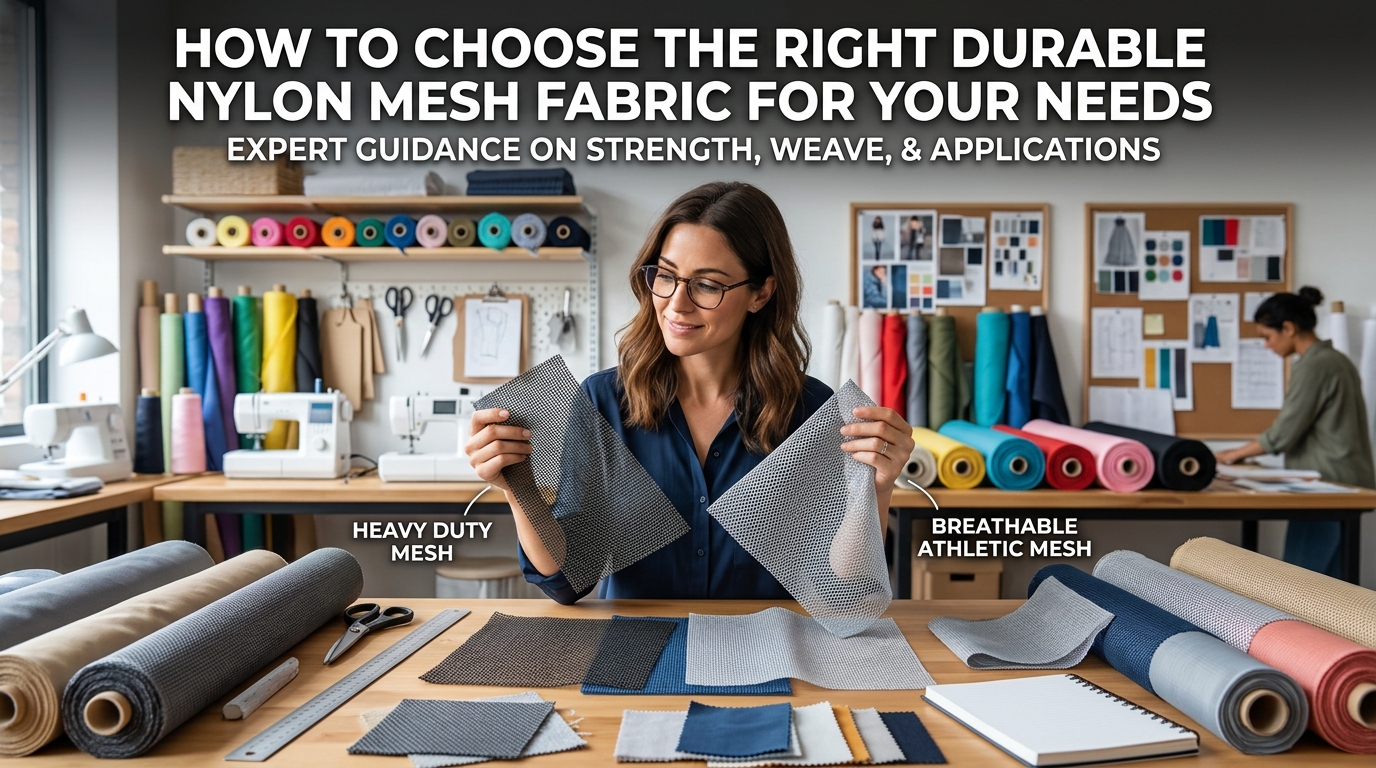
Durable nylon mesh fabric is a versatile textile widely used in backpacks, outdoor gear, sports products, storage bags, and industrial applications. Selecting the appropriate material goes far beyond yarn thickness or fabric weight. Durability depends on a combination of tensile strength, abrasion resistance, mesh opening size, breathability, dimensional stability, and the specific environmental conditions the fabric will face. Choosing incorrectly can result in premature wear, stretching, product failures, and higher material costs over time. This guide provides practical criteria for material selection, durability evaluation, fabric construction comparison, application matching, and supplier assessment so that buyers, designers, and manufacturers can make informed purchasing decisions.
Nylon mesh is an open-structure textile produced from nylon yarns or filaments. It combines high strength with flexibility, relatively low weight, and good airflow, making it suitable for applications that require both containment and ventilation. The optimal construction is never universal; it must be matched to the intended function, whether that is load-bearing storage, lightweight ventilation, or industrial filtration.
Common types include multifilament nylon mesh, which often delivers a softer hand and greater flexibility; monofilament nylon mesh, which can offer more defined openings and structural stability depending on how it is constructed; heavy-duty nylon mesh engineered for demanding uses that require greater support or wear resistance; and lightweight nylon mesh suited to ventilation panels, organizers, and weight-sensitive products.
When comparing nylon types, Nylon 6 and Nylon 66 differ primarily in thermal properties and certain mechanical characteristics. Nylon 66 generally provides higher heat resistance and slightly better dimensional stability in some applications, while Nylon 6 is widely used for its balance of strength, processability, and cost. Finished fabric performance, however, is determined far more by yarn quality, filament form, construction method, and finishing treatments than by the base polymer designation alone.
Tensile strength measures a fabric’s resistance to pulling forces and is a primary indicator of load-bearing capacity. Tear resistance describes how well the material resists the propagation of a cut or nick once damage begins. Both properties matter, yet the finished product’s seams, attachment points, and overall assembly often become the limiting factors in real-world performance.
Abrasion resistance concerns the ability of yarns and the mesh structure to withstand repeated friction. Snagging performance is a related but distinct property: a fabric may resist surface wear yet still catch and pull yarns when sharp objects contact it. These characteristics are especially relevant for backpack pockets, tool bags, and outdoor equipment that experience frequent contact with abrasive surfaces or pointed items.
Fabric weight (typically expressed in grams per square meter), thickness, and yarn denier influence handling, cost, and strength, but heavier yarns do not automatically produce a stronger finished fabric. Construction, yarn quality, and finishing play decisive roles. Buyers must weigh trade-offs among weight, flexibility, strength, and cost rather than assuming that higher denier or higher GSM is always better.
Mesh opening size directly affects ventilation, drainage, containment of objects, and overall flexibility. Dimensional stability under load determines whether the fabric maintains its shape and opening geometry during use. Opening size should be matched to the dimensions of items being stored or to the airflow and filtration requirements of the application.
Comparison Table 1: Key Nylon Mesh Fabric Properties
| Property | What to evaluate | Why it matters |
| Tensile strength | Resistance to pulling | Helps assess load-bearing performance |
| Tear resistance | Resistance to tear propagation | Helps prevent damage from cuts or stress |
| Abrasion resistance | Surface and yarn wear | Important for repeated contact |
| Mesh opening size | Opening dimensions and uniformity | Affects airflow and containment |
| Fabric weight | Grams per square meter (GSM) | Influences material weight and cost |
| Dimensional stability | Stretch and deformation | Helps maintain product shape |
| UV resistance | Performance after UV exposure | Relevant to outdoor service life |
Note: Actual test methods and acceptance thresholds should always be specified according to the intended application.
Warp-knit nylon mesh is formed by interlooping yarns primarily along the length of the fabric. This construction allows a wide range of structures, patterns, and degrees of flexibility, making it common in bags, sports products, and many technical textiles. Stability and snag resistance vary with the specific knitting pattern and yarn selection.
Weft-knit nylon mesh forms loops across the fabric width. It can offer notable stretch and flexibility, though recovery and long-term deformation depend heavily on the knitting structure and yarn specification. Careful evaluation of stretch recovery is essential when dimensional stability is required.
Woven nylon mesh interlaces yarns in defined patterns. Weave design governs opening geometry and dimensional stability, making woven constructions suitable for applications that need controlled openings or directional load support. Yarn slippage and directional strength should be assessed under the expected loading conditions.
Comparison Table 2: Nylon Mesh Construction Types
| Construction | Typical characteristics | Selection considerations |
| Warp-knit | Versatile structures and patterns | Evaluate stretch, stability, and snagging |
| Weft-knit | Potentially flexible and stretchable | Evaluate recovery and deformation |
| Woven | Defined yarn arrangement and openings | Evaluate yarn slippage and load direction |
Key takeaway: No single construction is inherently the strongest. Buyers should compare actual fabric specifications and test results rather than relying on construction type alone.
For backpacks, storage bags, and tool carriers, priority should be given to abrasion resistance, controlled pocket stretch, reliable object retention, and seam strength. Mesh used for small-item storage typically requires smaller openings than mesh intended primarily for ventilation.
Outdoor and sports equipment favor lower weight, good airflow and drainage, flexibility, and resistance to environmental exposure. Testing under repeated use and realistic outdoor conditions provides the most useful performance data.
Industrial and protective applications often demand high dimensional stability, chemical compatibility, filtration capability, or verified load support. Specialized protective uses may require standards-based testing or application-specific verification. In every case, begin by clearly defining the primary function of the mesh—storage, ventilation, support, filtration, or protection—before selecting the material.
Start by defining the intended use and operating environment. Identify the product type, expected loads, frequency of use, target service life, and exposure to sunlight, moisture, friction, heat, or chemicals.
Confirm material and yarn specifications in detail: nylon type, yarn denier, filament form (multifilament or monofilament), and whether high-tenacity yarn is required. Request full information on knitting or weaving construction, mesh opening dimensions, fabric weight, thickness, and usable width.
Balance strength, flexibility, airflow, and cost deliberately. Selecting the heaviest available fabric can raise material and processing costs without improving actual product performance. Fine mesh openings improve object containment but may reduce airflow and increase material consumption.
A practical technical specification checklist should include fiber composition and yarn specification; fabric construction and mesh opening size; GSM, thickness, width, and color; mechanical performance requirements; UV, moisture, or chemical resistance where needed; processing requirements, tolerances, and target cost. This structured approach supports consistent decision-making when choosing nylon mesh fabric for industrial and commercial applications.
Always request physical samples before committing to bulk purchases. Inspect mesh uniformity, yarn condition, flexibility, color consistency, and surface defects, then compare the sample against the written technical specification.
Conduct application-specific durability tests. Tensile and tear testing are essential for load-bearing products. Abrasion and snag testing matter for frequently handled items. Stretch and recovery evaluation is relevant for flexible components, while UV or chemical exposure testing is needed for demanding environments. Recognized methods such as ASTM D5034 for textile breaking strength and ASTM D3884 for abrasion resistance can provide useful reference points, but the applicable standard, test configuration, and suitability should be verified with the testing laboratory before requirements are finalized.
Inspect finished products and seams, not just the fabric itself. Test fabric-and-seam assemblies under representative loads, examine stitching, edge finishing, and localized stress points, and establish clear acceptance criteria before production begins.
Maintain batch consistency requirements by defining tolerances for weight, width, color, and mesh openings. Retain approved samples and inspection records. For critical applications, third-party testing can add an additional layer of assurance.
Prolonged sunlight exposure can reduce strength and alter appearance depending on the nylon grade and any UV-stabilizing treatments applied. Outdoor durability is therefore highly product-specific rather than a universal attribute of nylon mesh.
Moisture and chemical exposure vary widely. Wet-dry cycles, cleaning agents, oils, seawater, and other application-specific substances can affect performance differently. Resistance should never be assumed; it must be verified for the intended conditions.
Practical care involves following the supplier’s cleaning instructions, using only compatible cleaning agents, regularly inspecting for broken yarns, fraying, or deformation, and drying and storing the fabric according to its application requirements.
Evaluate technical expertise and manufacturing consistency by reviewing clear material specifications and documented test results. A capable supplier should be able to recommend constructions based on actual operating conditions and demonstrate the ability to maintain quality across production batches.
Compare pricing, minimum order quantities, and lead times in the context of total cost of ownership. Material consumption, processing waste, expected service life, sample fees, and customization costs often matter more than the simple price per meter.
Discuss customization options and long-term supply security, including available colors, widths, mesh openings, yarn specifications, finishing treatments, production capacity, and repeat-order consistency. Request written specifications for both approved samples and bulk orders.
Prospective buyers can discuss project requirements with Ningbo Nashe Textile Co., Ltd The company offers a range of nylon mesh constructions and material specifications, sample availability, customization options, quality documentation, and production capabilities suitable for varying MOQs and lead times. Contacting the team with application details, expected loads, operating environment, and target performance requirements is an effective way to identify a suitable mesh specification.
The right durable nylon mesh fabric is the one that meets the project’s actual performance requirements. Match construction and yarn specifications to the application, evaluate strength, abrasion resistance, mesh openings, and environmental durability, verify performance through physical samples and relevant testing, and compare suppliers on the basis of technical support, quality consistency, and total cost. The heaviest or most expensive option is not automatically the best; the material that performs reliably under the intended conditions is the correct choice.
11.1 What Is Durable Nylon Mesh Fabric?
Durable nylon mesh fabric is an open-structure textile made from nylon yarns or filaments. It combines strength, flexibility, low weight, and airflow, and is commonly used in backpacks, outdoor gear, sports products, storage bags, and industrial applications.
11.2 Is Nylon Mesh Stronger Than Polyester Mesh?
Relative strength depends on yarn specification, construction method, finishing treatments, and the specific performance requirements rather than the fiber name alone. Direct comparison of tested fabrics under the intended conditions is the only reliable way to decide.
11.3 What Is the Difference Between Heavy-Duty and Lightweight Nylon Mesh?
Heavy-duty versions typically use higher-denier yarns, higher fabric weight, and constructions optimized for greater support and abrasion resistance. Lightweight versions prioritize lower weight, greater flexibility, and higher airflow, making them suitable for ventilation and weight-sensitive products.
11.4 How Do I Choose the Right Mesh Opening Size?
Balance the need for ventilation and drainage against the requirement for object retention and structural integrity. Match opening dimensions to the size of items being contained or to the airflow and filtration needs of the application while considering dimensional stability under load.
11.5 How Can I Test the Durability of Nylon Mesh Fabric?
Begin with visual and tactile inspection of samples. Conduct application-relevant tensile, tear, abrasion, snag, stretch-recovery, and environmental exposure tests. Evaluate both the fabric and finished assemblies that include seams and attachment points.
11.6 Is Nylon Mesh Suitable for Outdoor Use?
Suitability depends on the specific nylon grade, presence of UV stabilizers, expected exposure conditions, and verified performance data. Not all nylon mesh performs equally outdoors; testing under realistic conditions is essential.
11.7 What Should I Ask a Nylon Mesh Fabric Supplier Before Ordering?
Request full details on construction, material and yarn specifications, available samples, relevant test data, minimum order quantity, production lead times, color and width options, finishing treatments, and the supplier’s ability to maintain consistency on repeat orders.
-