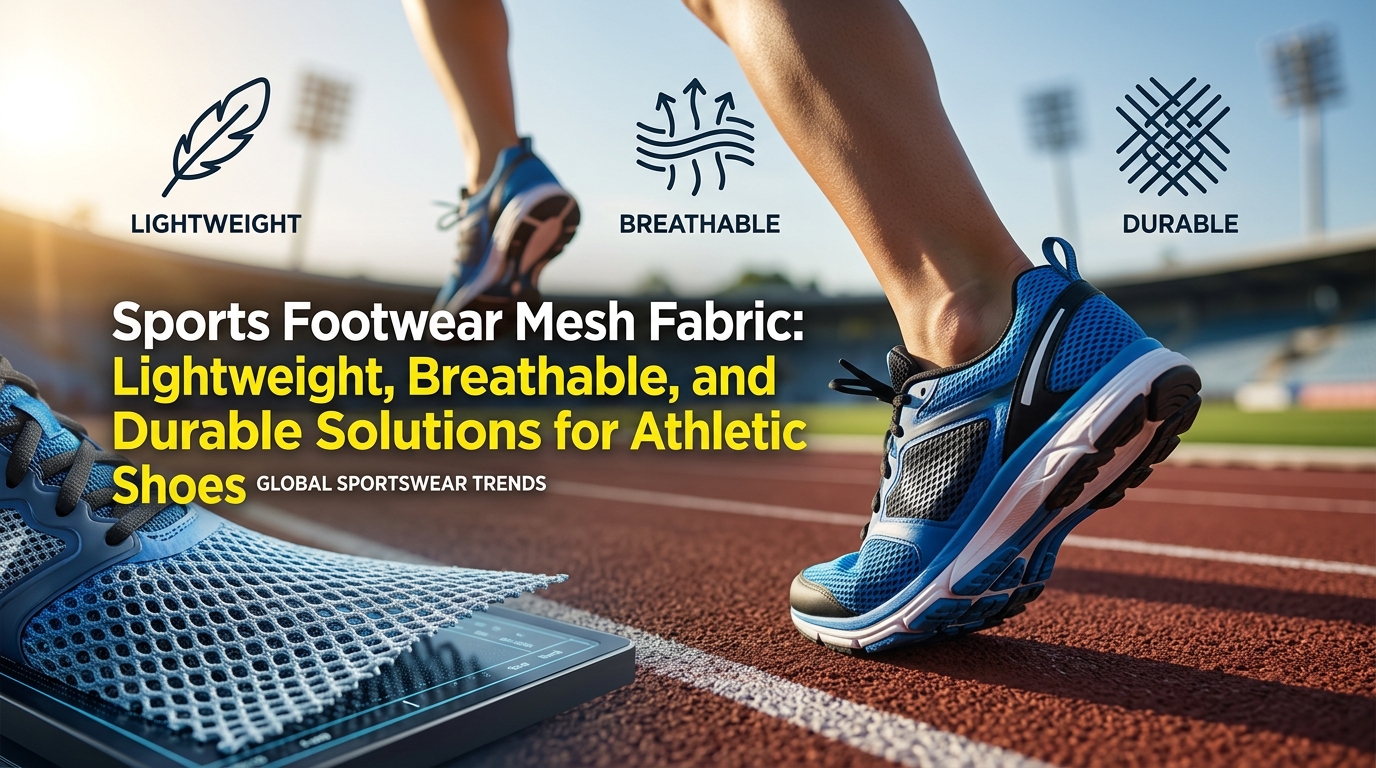
Sports Footwear Mesh Fabric is a specialized textile engineered for athletic shoe uppers, where the competing demands of airflow, low weight, flexibility, support, and durability must be met simultaneously. Unlike solid or densely woven materials, its open or carefully engineered structure creates pathways that allow air to move freely through the upper while still providing enough structural integrity for lasting footwear construction. Performance depends on far more than the size of the visible openings. Yarn selection, knitting density, fabric architecture, and finishing all interact to determine how the material behaves under the stresses of athletic use, manufacturing processes, and repeated wear.
Traditional dense upper materials often restrict airflow and add unnecessary weight, creating a heavier, warmer microclimate around the foot. Mesh addresses these limitations directly. By enabling ventilation, it helps manage heat and moisture buildup during activity. The reduction in material mass contributes to a lighter overall shoe, which can improve efficiency and reduce fatigue. Flexibility in the mesh supports natural foot motion and a more adaptive fit, while carefully designed constructions still deliver the structural support and durability required to hold the upper’s shape and withstand friction. The result is a balance of comfort, performance, and practicality that has made mesh a foundational material in modern athletic footwear.
Buyers and footwear developers evaluate mesh against a set of interrelated specifications that determine real-world suitability. Air permeability supports airflow through the upper. Lightweight construction helps reduce overall shoe weight. Abrasion resistance enables the fabric to withstand repeated friction. Tear strength helps resist damage from impacts or snags, while tensile strength contributes to structural durability. Controlled stretch allows the upper to adapt to foot movement without losing support. Dimensional stability maintains the intended shape through manufacturing and use. Moisture management supports comfort during prolonged activity, and water repellency can offer protection against light moisture without eliminating breathability.
| Performance characteristic | Why it matters in footwear |
| Air permeability | Helps improve airflow through the upper |
| Lightweight construction | Helps reduce overall shoe weight |
| Abrasion resistance | Helps withstand repeated friction |
| Tear strength | Helps resist fabric damage |
| Tensile strength | Supports structural durability |
| Stretch | Allows controlled adaptation to foot movement |
| Dimensional stability | Helps maintain upper shape |
| Moisture management | Supports comfort during activity |
| Water repellency | Can provide protection from light moisture |
Airflow through sports footwear mesh occurs via the spaces between yarns and the engineered architecture of the fabric itself. These pathways permit air exchange that helps dissipate heat and moisture generated by the foot. Evaluating air permeability solely by the visual size of mesh openings can be misleading. A fabric with moderately sized openings but optimized yarn arrangement and density may deliver more consistent and effective ventilation than one with large openings that compromise structural integrity. Laboratory measurement of air permeability, combined with assessment of the complete construction, provides a more reliable indicator of performance than appearance alone.
Lightweight performance is achieved through fine yarns, optimized knitting structures, and carefully controlled fabric density. Grams per square meter (GSM) remains a useful reference point, yet it must be considered alongside yarn specifications and construction type. A lower GSM can reduce material mass and contribute to a lighter shoe, but only if the resulting fabric retains sufficient strength and stability for the intended application. Comparing candidate meshes therefore requires attention to the full specification rather than weight in isolation.
An extremely open structure maximizes potential airflow but can sacrifice the support and dimensional control needed for a functional upper. Manufacturers address this trade-off by adjusting mesh opening size, overall fabric density, yarn diameter, knitting structure, localized reinforcement, and high-density zones. Strategic placement of denser areas in high-stress regions while keeping more open zones for ventilation allows the upper to remain both breathable and structurally sound.
Repeated friction is inevitable in athletic footwear, particularly around the toe box, side panels, heel counter interfaces, and any areas that contact other shoe components or external surfaces. Mesh must resist surface wear that would otherwise lead to thinning, pilling, or eventual failure. Abrasion resistance becomes especially critical in training shoes, basketball models, hiking boots, and outdoor footwear, where contact with ground surfaces, equipment, or rough terrain is frequent and intense.
Tear strength measures resistance to the propagation of a cut or snag once initiated, while tensile strength quantifies the force required to break the fabric under tension. Both properties matter. A fabric that is strong in tension may still tear readily if a small damage point appears. Footwear buyers should therefore request data on both characteristics rather than relying solely on fabric weight or a single strength figure. Adequate values in each category support long-term durability under the complex loads of athletic movement.
Mesh must maintain its intended dimensions through repeated stretching, bending, heat exposure during manufacturing, washing or cleaning cycles, lamination, bonding, cutting, and sewing. Loss of dimensional stability can produce distortion in the finished upper, inconsistent fit, or aesthetic defects. Stable constructions and appropriate yarn choices help ensure that the upper retains its designed geometry from production through the product’s service life.
Controlled stretch allows the upper to accommodate natural foot expansion and flexion during activity. Mechanical stretch arising from the knitted structure, multi-directional stretch from specific constructions, incorporation of elastic yarns, or specialized knit architectures can all contribute. Excessive stretch, however, reduces support and can compromise shape retention. The goal is a measured response that enhances comfort and biomechanical freedom without undermining the structural role of the upper.
Warp knitted mesh is produced by interlocking loops along the length of the fabric, often resulting in a stable and consistent structure. This stability makes warp knits particularly suitable where dimensional control and support are priorities. The relatively locked construction can limit excessive stretch while still permitting engineered openings for airflow, supporting applications that demand reliable shape retention under load.
Weft knitted mesh is formed by interlooping yarns across the width of the fabric. Depending on yarn selection and construction details, it can offer greater flexibility and a softer hand feel than many warp knitted counterparts. The potential for more pronounced stretch and drape can be advantageous in designs emphasizing comfort and adaptive fit, though careful engineering is required to maintain adequate support and durability.
Both polyester and nylon are widely used, yet fiber type alone does not dictate final performance. Yarn denier, filament count, fabric architecture, and finishing treatments exert strong influence.
| Characteristic | Polyester Mesh | Nylon Mesh |
| Lightweight potential | High | High |
| Abrasion resistance | Good to high, depending on construction | Often very good |
| Dimensional stability | Generally good | Good |
| Softness | Depends on yarn and construction | Often soft |
| Moisture behavior | Depends on yarn structure/finish | Depends on yarn structure/finish |
| Typical consideration | Weight, durability, stability, cost | Toughness, abrasion resistance, performance |
These variables operate as an interconnected system. Larger openings can enhance potential airflow but may reduce strength and support. Higher density or heavier GSM can improve durability at the cost of weight and sometimes breathability. Yarn selection influences strength, abrasion resistance, hand feel, and moisture behavior. Buyers should therefore evaluate the complete fabric specification—construction, GSM, opening size, density, yarn details, and measured performance data—rather than selecting on the basis of any single attribute.
Airflow alone does not equal effective moisture management. True moisture management involves the absorption or transport of perspiration away from the skin, spreading of moisture across a larger surface area, and subsequent evaporation. Fiber chemistry, yarn structure, fabric architecture, and surface finishes all influence how efficiently moisture moves through and out of the upper.
Drying speed is governed by fiber selection, yarn engineering, fabric openness, and any applied finishes. Hydrophobic or specially engineered yarns, combined with constructions that promote rapid evaporation, help the upper return to a dry state more quickly after activity or exposure to moisture, supporting sustained comfort.
Softness, flexibility, bending comfort, surface texture, and the way the fabric interacts with the foot and sock contribute to overall comfort. The softest mesh is not automatically the most suitable for every athletic shoe. In high-support or high-abrasion applications, a firmer hand may be preferable if it delivers the required durability and stability.
Clear distinctions are essential. Breathability permits air movement. Water repellency helps water droplets bead and roll off the surface rather than wetting it. Water resistance provides greater barrier performance against penetration. Waterproofing is engineered to prevent water entry under defined conditions, typically as part of a complete footwear system rather than the mesh alone. A water-repellent mesh should never be described as waterproof.
| Property | Meaning | Typical footwear application |
| Breathability | Allows air movement | Running and training shoes |
| Water repellency | Helps water droplets resist wetting the surface | Light rain and damp environments |
| Water resistance | Provides greater resistance to water penetration | Outdoor footwear |
| Waterproofing | Designed to prevent water penetration under specified conditions | Waterproof outdoor shoes |
Running applications typically prioritize low weight, high breathability, flexibility, effective moisture management, controlled stretch, and a comfortable, adaptive fit. Because distance and continuous forward motion generate significant heat and moisture, mesh constructions that maximize airflow while remaining light and flexible are favored. Support requirements are generally lower than in multi-directional sports, allowing greater emphasis on ventilation and mass reduction.
Training shoes encounter a broader range of movements, including lateral work, impact, and frequent direction changes. Mesh for these models therefore needs a stronger balance of flexibility, support, abrasion resistance, and dimensional stability. The fabric must accommodate dynamic motion without excessive stretch or loss of shape, while resisting the wear associated with varied gym and field surfaces.
Basketball involves repeated lateral cuts, rapid stops and starts, and significant bending of the upper. These demands elevate the importance of structural stability, durability, and controlled stretch. Mesh constructions for basketball often incorporate denser zones or higher-strength yarns to resist abrasion and maintain support under high lateral loads, even if this results in a slightly higher weight or moderated openness compared with pure running meshes.
Both sports generate substantial lateral forces, friction against the ground or ball, and repetitive high-intensity movement. Material selection must therefore emphasize abrasion resistance, tear strength, and dimensional stability alongside adequate breathability. Sport-specific patterns of contact and stress further influence preferred constructions and reinforcement strategies.
Outdoor environments introduce abrasion from rough terrain, potential moisture exposure, and the need for lasting structural integrity. Mesh for hiking and outdoor use commonly prioritizes abrasion resistance, tear strength, dimensional stability, water repellency, structural support, and resistance to environmental degradation. Breathability remains valuable but is balanced against protection and durability requirements that exceed those of indoor or road-running applications.
Selection begins with the intended footwear application, the movement patterns involved, the expected environment, and the desired product lifespan. Polyester and nylon remain primary options, with recycled variants increasingly available. Yarn fineness, strength, and any engineered modifications further refine performance. The fiber choice should align with the dominant performance priorities of the shoe category.
Construction type—warp or weft knit, density, mesh opening geometry, and any zoned structures—determines how the fabric will behave under load and during manufacturing. Review of GSM, width, stretch characteristics, and dimensional stability data helps confirm suitability for the specific upper design.
Relevant laboratory or supplier test results should be examined for air permeability, abrasion resistance, tear and tensile strength, stretch and recovery, moisture management, and water repellency where applicable. Matching these measured values to the demands of the target sport and use environment reduces the risk of under- or over-specifying the material.
Mesh must perform reliably during cutting, sewing, heat pressing, bonding, lamination, and final assembly. Consistency in thickness, stretch, and surface characteristics influences production efficiency, seam quality, and finished-shoe appearance. Compatibility with existing manufacturing processes and adhesives or coatings is therefore a practical selection criterion.
Reliable production depends on controlled variation in GSM, fabric width, mesh uniformity, stretch, color, dimensional stability, and surface appearance. Suppliers who maintain tight process controls and provide documentation of consistency support efficient manufacturing and uniform product quality across production runs.
Footwear developers can use performance priorities as a practical filter when comparing candidates.
| Footwear requirement | Mesh characteristic to prioritize |
| Maximum ventilation | Air permeability and suitable mesh opening |
| Lightweight running shoe | Low GSM with sufficient strength |
| Training shoe | Abrasion resistance + support + flexibility |
| Basketball shoe | Structural stability + durability + controlled stretch |
| Outdoor shoe | Abrasion resistance + stability + water repellency |
| Comfortable lifestyle shoe | Softness + flexibility + breathability |
No single attribute—high breathability, low GSM, or high stretch—defines a successful footwear mesh. Each material functions as a complete performance system in which strength, stability, moisture behavior, and manufacturing behavior interact. Evaluating candidates holistically against the specific requirements of the shoe category yields more reliable outcomes than optimization of any isolated property.
Advances in finer yet stronger yarns and optimized textile structures continue to push the boundary between low weight and required durability. The goal is to reduce material mass without compromising the abrasion resistance, tear strength, or support needed for athletic use.
Zoned constructions allow different regions of the upper to employ distinct structures: open zones for ventilation, denser zones for support, reinforced zones for abrasion resistance, and more flexible zones to accommodate foot movement. Three-dimensional architectures further expand design possibilities by adding engineered volume and localized performance differentiation within a single fabric.
Recycled polyester and recycled nylon are increasingly incorporated into footwear mesh development. Sustainability claims should be supported by clear material documentation and supply-chain transparency so that environmental benefits can be verified and communicated accurately.
Sports Footwear Mesh Fabric has evolved well beyond a simple breathable textile. It is now a sophisticated performance material whose success depends on the careful balancing of lightweight construction, breathability, support, durability, flexibility, moisture management, and comfort. The appropriate specification is dictated by the footwear application rather than any universal performance target. Running shoes may emphasize openness and low mass, while basketball or outdoor models demand greater structural integrity and abrasion resistance. For manufacturers and sourcing teams evaluating materials, Ningbo Nashe Textile Co., Ltd. represents a potential supplier resource. Readers are encouraged to contact the team when specific footwear mesh requirements need to be discussed in detail.
What is Sports Footwear Mesh Fabric?
It is a textile material engineered for athletic shoe uppers to provide airflow, low weight, flexibility, support, and durability. Its open or structured architecture allows air exchange while maintaining sufficient integrity for footwear construction and use.
What are the main benefits of Sports Footwear Mesh Fabric?
Primary benefits include lightweight construction that reduces overall shoe mass, enhanced airflow for thermal comfort, flexibility that supports natural foot movement, improved comfort through moisture management, and durability tailored to the demands of specific sports and environments.
Is footwear mesh fabric waterproof?
No. Mesh is inherently breathable. Water-repellent finishes can help water droplets resist wetting the surface, but true waterproofing is achieved through complete footwear systems that typically incorporate membranes or other barriers. A water-repellent mesh should not be described as waterproof.
What is the difference between polyester and nylon footwear mesh?
Both fibers offer strong lightweight potential and good dimensional stability. Nylon often provides particularly high abrasion resistance and toughness, while polyester is frequently chosen for a balance of weight, durability, stability, and cost. Final performance depends heavily on yarn engineering and fabric construction rather than fiber type alone.
Is mesh suitable for running shoes?
Yes. Running footwear commonly employs mesh when low weight, high airflow, flexibility, and comfort are priorities, as continuous forward motion generates significant heat and moisture that benefit from effective ventilation.
Is mesh suitable for basketball shoes?
Yes, provided the construction is selected for the sport’s demands. Basketball requires greater structural support, abrasion resistance, and controlled stretch to handle lateral forces and rapid direction changes, so denser or reinforced mesh variants are typically preferred over the most open running meshes.
How do you test Sports Footwear Mesh Fabric?
Relevant testing categories include air permeability, abrasion resistance, tensile strength, tear strength, stretch and recovery, dimensional stability, and moisture-management or drying performance. Suppliers should provide data from standardized laboratory methods appropriate to the intended application.
What GSM should footwear mesh fabric have?
There is no universal GSM. Appropriate fabric weight depends on the footwear design, required strength and support, and the balance sought between lightness and durability. Evaluation of the complete specification is more informative than any single weight figure.
How does mesh size affect breathability?
Larger openings can increase potential airflow, yet fabric density, yarn arrangement, and overall construction also govern actual air permeability and the resulting strength and support. Optimal performance results from balancing opening size with these other structural factors.
How can buyers select the right footwear mesh supplier?
Key considerations include demonstrated technical capability in sports mesh, consistent production quality, availability of relevant test data, customization options, robust quality-control processes, and proven compatibility with footwear manufacturing methods.
-